Haloview BT7 vs Furrion: Which RV Camera Fits? (November 2026)
Pick the Yakry Furrion-compatible kit for the simplest install on a pre-wired RV, or the Haloview BT7 for longer range and full-color night vision. In this haloview bt7 vs furrion comparison, wiring and how you tow matter more than the brand on the box.
On this page (9 sections)
- Haloview BT7 vs Furrion-compatible kit: which wiring fits your camper?
- How far does each camera's signal reach?
- Which gives the clearer night picture?
- How do the monitors and controls compare?
- How wide is the view, and what does that mean when reversing?
- How tough is each camera in weather?
- Who should buy which RV camera?
- How we scored these cameras
- Verdict: which RV camera should you buy?
Pick the Yakry Furrion-compatible kit for the simplest install on a pre-wired RV, or the Haloview BT7 for longer range and full-color night vision. In this haloview bt7 vs furrion comparison, wiring and how you tow matter more than the brand on the box.
The Yakry kit comes with a Furrion bracket and pigtail wire, so it slots into the housing many campers already have. The Haloview BT7 brings a longer wireless reach and a brighter night picture.
Neither is the wrong call for every rig.
We compared the specs and features of three systems: the Yakry kit built for Furrion pre-wired RVs, the standard Haloview BT7 and the BT7 Touch. This guide walks through wiring, signal, night vision and monitor controls so you can match one to your trailer.
 Best for Furrion pre-wired RVs
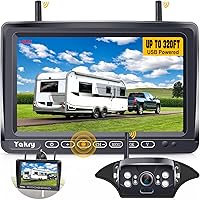
Yakry Wireless RV Backup Camera for Furrion Pre-Wired RVs

Haloview BT7 vs Furrion-compatible kit: which wiring fits your camper?
The Furrion-compatible Yakry kit wins on wiring if your RV already has a Furrion housing. It includes a Furrion bracket and pigtail wire, so the camera drops into the mount and connects to the pre-run cable.
Many travel trailers and fifth wheels leave the factory with a Furrion camera prep package. That prep gives you a mounting point and a cable already routed to the rear.
The Yakry kit is built to use both.
Haloview takes a different path. The BT7 supports Furrion pre-wired RVs, so it can also use the factory housing.
You still mount the monitor in the cab and pair the camera, but the rear wiring is already there.
If your camper has no camera prep, wiring becomes the deciding factor. Both systems are wireless, so the camera needs power at the rear.
You'll tap a reverse light or a running light either way.
Our guide on how to hook up a backup camera on an RV covers the power tap and pairing steps. Read it before you buy so you know which mount your rig offers.
When the Furrion bracket decides it
Choose the Yakry kit when the Furrion housing is already on the back wall. The bracket and pigtail remove a drill and a trip to the parts store.
The kit also handles a mixed fleet. You can move it between a trailer with Furrion prep and one without, because the mount adapts.
When the Haloview adapter wins
The BT7 suits a pre-wired camper where you want Haloview's picture quality and range. Its Furrion support lets you keep the factory housing and still get the longer signal.
If you later switch rigs without Furrion prep, the BT7 still mounts with its own hardware. That flexibility helps when you trade trailers.
How far does each camera's signal reach?
The Haloview BT7 reaches farther on paper, at up to 984 feet line of sight, while the Yakry kit lists 825 feet in open areas. For most trailers both are plenty; the gap matters on the longest fifth wheels.
Line-of-sight range is the clean, open-air number. Real-world range drops once the signal passes through walls, appliances and people.
The Yakry kit also lists a 320-foot working range on vehicles, which is a more honest figure for towing.
A 30-foot travel trailer puts the camera about 30 to 40 feet from the cab. Either system covers that easily.
A 40-foot fifth wheel adds height and more metal between the camera and the monitor.
The BT7's longer reach gives you more margin. The Yakry kit's dual antennas help hold a steady signal, and Yakry says its chip lifts the refresh rate by 50%.
That matters when the picture would otherwise stutter at highway speed.
Which holds up in traffic?
Both use wireless links that can pick up interference near cities and truck stops. The BT7's new-gen wireless tech is built to cut lag and interference.
The Yakry dual-antenna design aims at the same problem from the hardware side.
Which is better for a long trailer?
The BT7 for the longest rigs. Its 984-foot line-of-sight figure leaves more room before the signal weakens.
The Yakry kit is still a solid choice up to its 825-foot open-area limit.
Which gives the clearer night picture?
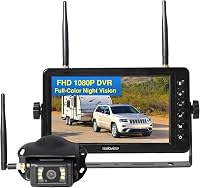
The Haloview BT7 wins on night vision, because its sensor keeps a full-color image in dim light. The Yakry kit uses infrared lights for a black-and-white picture after dark.
Haloview says its image sensor is sensitive enough to absorb more visible light and keep color when the light drops. The BT7 uses a 1/2.9-inch CMOS sensor.
The BT7 Touch steps up to a 1/2.7-inch sensor.
The Yakry kit takes the familiar infrared route. It has 8 infrared lights that switch on in low light and show a clear image in black and white.
Its 0.1 lux rating means it works in very dark settings.
Color at night helps you spot a person, a parked car or a curb more easily. Infrared gives you a longer, more even reach in total darkness.
Which one you want depends on where you park.
Color night vision for tight campgrounds
The BT7's full-color dim-light picture helps in crowded campgrounds. You can tell a picnic table from a shadow and see the color of a neighbor's gear.
Infrared reach for dark boondocking spots
The Yakry kit's infrared lights cut through pitch black. On a dark rural site with no floodlights, that steady black-and-white image is easier to read than a color picture that fades.
How do the monitors and controls compare?
The BT7 Touch wins on controls, with a 7-inch 2.5D curved glass touch screen and smart brightness adjustment. The standard BT7 uses a 7-inch LCD with button controls.
All three monitors show a 7-inch picture. The Yakry kit's touch keys handle its menu and camera switching.
The standard BT7 uses buttons on the monitor body.
The BT7 Touch adds a smooth glass touch layer. Its smart brightness adjustment dims the screen in low light, which cuts glare and eye strain on night drives.
That's a real comfort gain on long tows.
Haloview's BT7 Touch also skips support for Haloview tire pressure sensors. If you want to add TPMS later, the standard BT7 is the better base.
If you're weighing the two Haloview versions directly, our Haloview BT7 vs BT7 Touch comparison goes deeper on the screen and brightness differences.
Recording and extra cameras
All three record. The Yakry kit doubles as a dash cam with 1080P video.
Both BT7 versions have a built-in recorder at 1080P and 30fps. The Yakry kit and the BT7 both support up to 4 wireless cameras.
Screen size and cab space
Each monitor is 7 inches, so cab space is a wash. The BT7 Touch measures about 7 x 4.5 x 0.72 inches.
Check your dash before mounting any of them.
How wide is the view, and what does that mean when reversing?
The Yakry kit's 150-degree lens sees wider than the Haloview's 120-degree lens. A wider view shows more of the lane and curb behind you, while a narrower lens stretches less at the edges.
Field of view is one of the few places the Furrion-compatible kit beats the BT7 on paper. At 150 degrees, the Yakry camera takes in more of the scene behind the bumper.
The BT7 and BT7 Touch both list 120 degrees. That's still wide enough for reversing and lane changes, but it crops more of the far edges.
A wider lens helps when you back into a tight site or swing into a campsite road. It also makes objects at the edge look smaller, so judge distance by the screen's guide lines rather than by eye.
Backup lines and view modes
The Yakry kit lets you turn the backup lines on or off. It also runs as a reversing camera or a full-time constant rear view.
That constant mode is handy as a rear-view mirror replacement while towing.
The BT7 systems handle rear view and multi-camera switching through the monitor. Both are wireless, so no cable runs from the cab to the rear.
How tough is each camera in weather?
Both handle weather well, but the Yakry kit states an IP69K waterproof rating. That's the highest water and dust protection class, which suits rain, road spray and washdowns.
The Haloview BT7 doesn't list an IP rating in its specs. Its camera is built for exterior mounting on trailers and trucks, but the Yakry kit puts its weather protection in writing.
If you tow through heavy rain or store the camper outside, the IP69K figure on the Yakry kit is a real advantage. It's the kind of spec that matters after a few seasons.
Mounting and vibration
Both mount on the rear wall. The Yakry kit's bracket mount and surface mount options fit the Furrion prep.
The BT7 uses a surface mount. Either way, check the screws and seal the cable entry.
Who should buy which RV camera?
Buy the Yakry Furrion-compatible kit if your camper is pre-wired for Furrion and you want the easiest install. It's the top pick overall for most towable owners.
The kit's Furrion bracket and pigtail wire turn a wiring job into a bolt-on. Its dual antennas, 1080P monitor and 4-camera support cover the basics well.
It also records like a dash cam and states an IP69K rating.
Buy the Haloview BT7 if you tow a long trailer and want the longest range and full-color night vision. Its 984-foot line-of-sight range and color dim-light picture suit big fifth wheels and dark campsites.
Buy the BT7 Touch if touch controls and auto-dimming matter more to you than tire pressure support. The glass screen and brightness adjustment make night driving easier.
Skip the Touch if you plan to add Haloview tire pressure sensors. The standard BT7 leaves that door open.
For motorhomes and Class A rigs
A Class A motorhome puts the camera far from the driver and often high up. The BT7's longer range helps there.
Our roundup of the best backup cameras for motorhomes covers more options for big rigs.
For small trailers and campers
A short camper needs less range. The Yakry kit's easy Furrion fit makes it the low-fuss pick for a small travel trailer.
How we scored these cameras
Our score weighs specs, features and fit against what an RV owner wants: a clear picture, a steady signal and a mount that works with the camper. The Yakry kit scores 8.8 on the strength of its Furrion fit and wide lens.
The BT7 scores 8.4 for range and night vision. The BT7 Touch scores 7.6, lower because the touch screen adds cost and drops tire pressure support.
Verdict: which RV camera should you buy?
The Yakry Furrion-compatible kit is the best overall pick for most RV owners. In this haloview bt7 vs furrion matchup, its included bracket and pigtail make it the easiest to install on a pre-wired camper.
The 150-degree lens and IP69K rating add real value.
Choose the Haloview BT7 when range and night vision decide it. Its 984-foot reach and full-color dim-light picture suit long fifth wheels and dark sites.
The BT7 Touch is the pick only if you want a touch screen and don't need tire pressure sensors.
Check your camper's rear wall first. If a Furrion housing is there, the Yakry kit is the natural fit.
If not, or if you tow the longest rigs, the BT7 earns its place. For a wider brand comparison, see our Haloview vs AUTO-VOX RV camera breakdown.
Frequently asked questions
Is the Haloview BT7 compatible with a Furrion pre-wired RV?
Yes. The Haloview BT7 supports Furrion pre-wired RVs, so the camera can use the housing and wiring already on your camper.
You still mount the monitor in the cab and pair the two, but you skip running a new cable to the rear.
Does the Yakry kit replace a Furrion camera directly?
Yes. The Yakry Y27 includes a Furrion bracket and pigtail wire, so it fits the housing Furrion leaves on many pre-wired RVs.
That makes it a plug-and-play swap for a factory Furrion camera, with no new bracket to drill.
Which has the longer wireless range, Haloview BT7 or Furrion?
The Haloview BT7 lists a wireless line-of-sight range up to 984 feet. Furrion's own kit isn't in this comparison, but the Yakry Furrion-compatible kit reaches up to 825 feet in open areas, with a 320-foot working range on vehicles.
Do I need a touch screen on an RV backup camera?
No. The button BT7 runs the same 7-inch monitor and camera, so the touch screen is a convenience, not a requirement.
Pick the BT7 Touch if tapping menus is easier than pressing buttons while stopped.
Which camera is better for a fifth wheel?
The Haloview BT7 is the better fit for a long fifth wheel, because its 984-foot line-of-sight range covers the distance from the rear of the trailer to the cab. The Yakry kit's 825-foot open-area range also works, but the extra reach helps on the longest rigs.
Can I add more cameras to these systems?
Yes. The Yakry Y27 and both Haloview BT7 versions support up to 4 wireless cameras.
That lets you add a second rear camera or a side camera later without replacing the monitor.